
Why Every Growing Business Needs a Strong HR Foundation.
A strong HR foundation helps growing businesses manage people effectively, create workplace clarity and build sustainable systems for growth. Discover the key HR structures every growing business should consider.
J&J Editorial Team
490 Readers
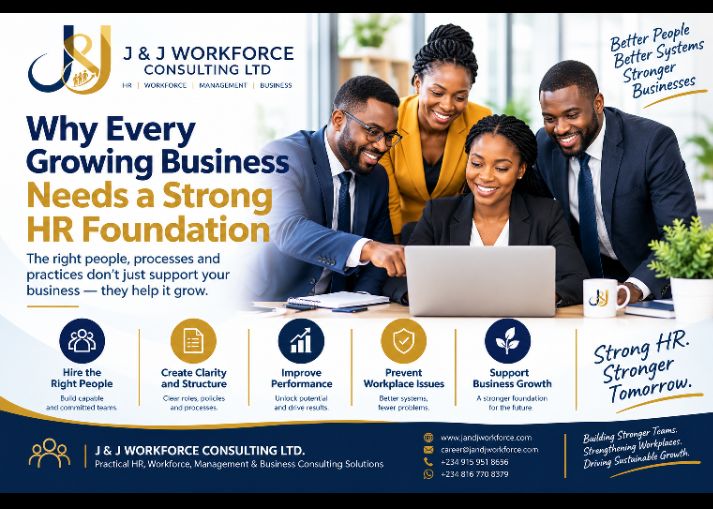
WHY EVERY GROWING BUSINESS NEEDS A STRONG HR FOUNDATION
By J&J Workforce Consulting Ltd.
As a business grows, attention naturally goes to sales, customers, revenue and expansion. But there is another area that can determine whether that growth is sustainable: people management.
Many small and growing businesses start with a simple structure. A few employees are hired, responsibilities are shared informally, and decisions are made as situations arise. This may work during the early stages of a business.
However, as the organisation grows, the same informal approach can begin to create challenges.
Employees may become unclear about their responsibilities. Recruitment may become rushed. Attendance and leave may not be properly documented. Performance expectations may not be clearly communicated. Workplace issues may be handled inconsistently. Management may also find it difficult to keep track of employee records and HR processes.
This is where a strong HR foundation becomes important.
WHAT IS AN HR FOUNDATION?
An HR foundation is the basic structure, policies, processes and practices an organisation needs to manage its people effectively.
It does not necessarily mean having a large HR department or complicated systems.
For a small or growing business, an effective HR foundation may include:
- Clear organisational roles and responsibilities
- Proper employee records and documentation
- Recruitment and onboarding processes
- Attendance, leave and workplace procedures
- Clear policies and expectations
- Performance management processes
- Employee communication and engagement
- Training and development
- Employee relations practices
- Basic workforce planning
The goal is to create a workplace where employees understand what is expected of them and management has the structure needed to make informed people-related decisions.
WHY DOES IT MATTER?
1. It Helps the Business Hire More Effectively
Recruitment is more than simply finding someone who can do a job.
Businesses need to understand the role they are hiring for, the skills required, the responsibilities involved and the type of person who will fit the organisation.
A structured recruitment process helps businesses define their requirements, attract suitable candidates, screen applicants and make better-informed hiring decisions.
2. It Creates Clarity for Employees
Employees perform better when they understand their responsibilities, reporting relationships and performance expectations.
Clear job responsibilities and workplace procedures reduce confusion and help employees understand how their work contributes to the organisation.
3. It Supports Better Performance Management
Performance should not only be discussed when something goes wrong.
Businesses can establish clear expectations, communicate objectives, provide feedback and identify areas where employees may need additional support or training.
A structured performance management process can help management identify both strengths and areas for improvement.
4. It Helps Prevent Avoidable Workplace Problems
Not every workplace problem can be prevented, but many can be managed better when appropriate procedures are already in place.
Clear policies, documentation and communication provide a framework for handling issues relating to attendance, conduct, leave, performance and employee relations.
5. It Supports Business Growth
As the number of employees increases, informal people-management practices can become increasingly difficult to maintain.
A business that establishes appropriate HR processes early can create a stronger foundation for future growth.
Instead of constantly reacting to people-related problems, management can work with clearer systems and processes.
HR IS NOT ONLY FOR LARGE COMPANIES
One common misconception is that HR systems are only necessary for large organisations.
In reality, small and growing businesses can also benefit from having appropriate HR structures.
The difference is that the HR system should be proportionate to the size and needs of the business.
A five-person business does not necessarily need the same HR structure as a 500-person organisation.
What matters is having the right processes for the organisation's current stage of growth and being prepared to develop those processes as the business expands.
WHAT SHOULD A GROWING BUSINESS DO FIRST?
There is no single HR structure that works for every organisation.
A business should first understand its current situation and identify the areas requiring attention.
This may involve reviewing:
- Current employee structure
- Recruitment practices
- Employee records
- Workplace policies
- Attendance and leave management
- Job descriptions
- Performance management
- Training needs
- Employee relations
- Organisational structure
- Workforce requirements
From there, the business can prioritise the areas that require immediate attention and gradually build the appropriate HR framework.
THE ROLE OF PRACTICAL HR CONSULTING
Good HR consulting should not simply produce documents that remain unused.
The real value comes from understanding the organisation, identifying its needs and helping management implement practical solutions.
At J&J Workforce Consulting Ltd., our approach is built around understanding the client, assessing the relevant people and processes, recommending suitable solutions, supporting implementation and evaluating outcomes.
We understand that every organisation is different. That is why our approach is tailored to the specific needs, objectives and stage of each business.
Whether a business needs support with HR setup, recruitment, employee relations, performance management, training, workforce planning or broader management processes, the objective is to provide practical solutions that create value.
BUILDING THE FOUNDATION FOR SUSTAINABLE GROWTH
Business growth is not only about acquiring more customers or increasing revenue.
Sustainable growth also requires the organisation to develop the people, systems and processes needed to support that growth.
When employees understand their roles, managers have appropriate processes, recruitment is structured and workplace practices are clearly defined, the organisation is better positioned to manage growth effectively.
A strong HR foundation does not have to be complicated.
It simply needs to be appropriate, practical, consistent and capable of growing with the organisation.
FINAL THOUGHT
If your business is growing and people-related challenges are becoming more difficult to manage, it may be time to look beyond individual problems and examine the systems supporting your workforce.
The right HR foundation can help create greater clarity, stronger workplace practices and a more organised environment for both employees and management.
At J&J Workforce Consulting Ltd., we help organisations build stronger teams, strengthen workplace systems and develop practical people solutions that support sustainable business growth.
For enquiries and consulting support:
J&J Workforce Consulting Ltd.
Website: www.jandjworkforce.com
Email: career@jandjworkforce.com
Telephone: +234 915 951 8656
WhatsApp: +234 816 770 8379
Practical HR, Workforce, Management & Business Consulting Solutions
Building Stronger Teams. Strengthening Workplaces. Driving Sustainable Growth.